Does Overclocking Your GPU Actually Improve AI Deepfake Processing?
Does Overclocking Your GPU Actually Improve AI Deepfake Processing?
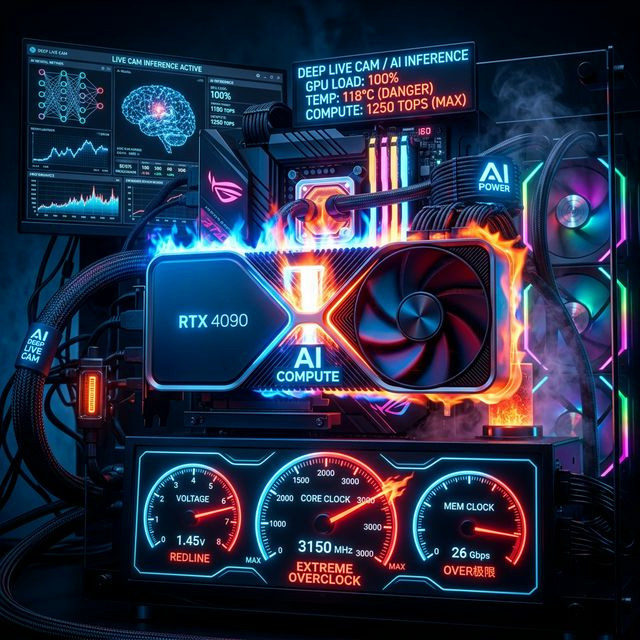
When PC gamers want an extra 10 frames per second in Cyberpunk, they reach for MSI Afterburner to manipulate their GPU voltage and core clocks. Naturally, users attempting to squeeze 60 FPS out of heavy Deep Live Cam renders wonder if the same brutal hardware manipulation applies to artificial neural networks. The answer is highly nuanced and fraught with severe risk.
Matrix Multiplication vs Rendering Polygons
Traditional gaming relies on geometry rasterization; a slightly faster core clock directly pushes out more rendered frames. Deep learning, however, relies exclusively on tensor core matrix multiplications. Pushing the core GPU clock up by 150MHz often yields less than a 2% performance gain in actual `onnxruntime` inference speeds. The bottleneck isn't the raw speed of the chip processing the math—it's the speed at which it can fetch the data.
The VRAM Memory Bandwidth Factor
If you genuinely want to overclock an AI workflow, ignore the core clock completely and focus on the Memory Clock (VRAM bandwidth). Neural networks are massive data structures. Accelerating the speed at which VRAM shuttles the model back and forth to the tensor processors can yield noticeable (5% to 8%) reductions in latency.
However, AI processing hits the silicon incredibly hard, with sustained, unyielding 100% computational loads. Aggressively overclocking a GPU running Deep Live Cam will routinely cause catastrophic thermal throttling or immediate driver crashes. For 99% of users, the microscopic latency gains are absolutely not worth the system instability during a live broadcast. Undervolting for thermal efficiency remains the vastly superior strategy.


