How to Setup a Dedicated Dual-PC Streaming Deepfake Rig
How to Setup a Dedicated Dual-PC Streaming Deepfake Rig
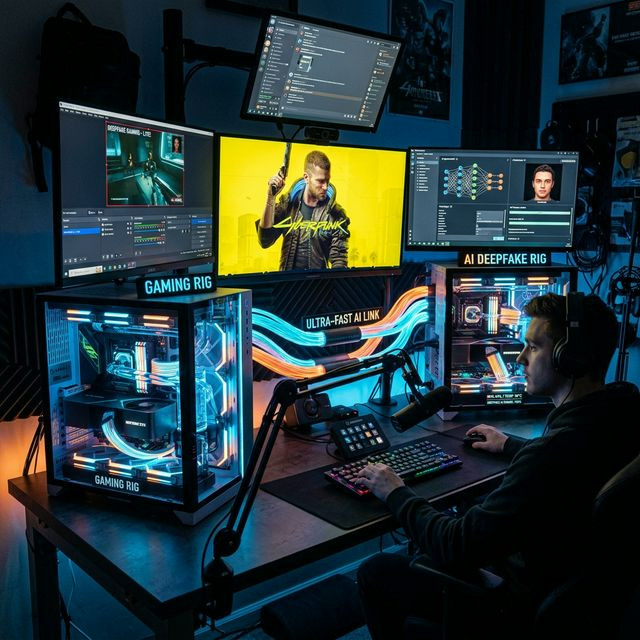
When you aggressively deploy generative AI overlays alongside highly demanding AAA video games, a single processor physically cannot execute both tasks without dropping crucial frames. The sheer architectural mathematics required for real-time tracking demands a dedicated machine. Professional, high-tier Anonymous VTubers and deepfake broadcasters invariably rely on the Dual-PC Pipeline.
The Roles of the Hardware
PC 1 (The Gaming Box): This machine's entire purpose is pushing maximum FPS in the video game to your primary 144Hz monitor. It handles no capture, no OBS, and zero AI math. It simply passes a raw HDMI signal out of the graphics card and directly into the capture card of the second machine.
PC 2 (The AI Encoder Box): This is the workhorse. You connect your physical webcam and microphone entirely to this machine. Its powerful NVIDIA GPU is 100% dedicated to running the Python scripting for Deep Live Cam seamlessly, running CodeFormer enhancements, wrapping the synthesized output into OBS, encoding the final scene via NVENC, and broadcasting the packets to Twitch.
The NDI Alternative Protocol
If purchasing physical PCIe Capture Cards (like Elgato) is impossible, the modern alternative is NDI (Network Device Interface). By connecting both computers via an ultra-fast gigabit ethernet switch, the Gaming PC packages the raw game footage into raw IP packets and shoots them across the LAN cable directly into OBS on the AI Encoder Machine. This allows the AI computer to effortlessly merge the raw game footage with the complex neural network camera overlay, achieving Hollywood production values with zero gaming latency.


