Understanding the Differences: DeepFaceLab vs Deep Live Cam
Understanding the Differences: DeepFaceLab vs Deep Live Cam
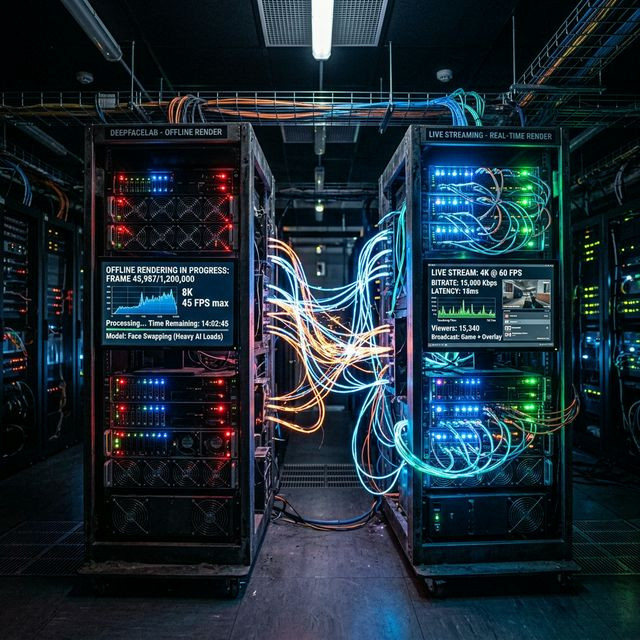
Within the deepfake engineering community, there are two distinct, highly polarized methodologies: Offline Rendering vs Live Inference. The absolute crown jewel of offline manipulation is DeepFaceLab (DFL), while the modern champion of live inference is Deep Live Cam (DLC). Despite producing similar final illusions, their architectures are universally different.
DeepFaceLab: The Hollywood Workflow
DeepFaceLab does not just swap a face; it surgically constructs an entirely bespoke neural network specifically trained on *one* person. You must extract 5,000 photos of Tom Cruise's face and let your GPU calculate mathematical weights for 10 consecutive days. The resulting model is completely useless for anything except Tom Cruise. However, because the network is deeply tailored over millions of iterations, the final offline render is completely flawless, artifact-free, broadcast-television quality.
Deep Live Cam: The Zero-Shot Miracle
Deep Live Cam operates on "Zero-Shot Inference." It uses a pre-trained, generalized matrix (the `inswapper` model) that already understands the fundamental geometry of *all* human faces. You feed it a single picture of Tom Cruise, and it instantly calculates an approximation in 30 milliseconds. There is zero training time.
The tradeoff? Because the DLC model is generalized to process millions of different faces at 60 FPS, its final output will never possess the absolute, pixel-perfect microscopic detail of a 10-day DFL render. DFL is for cinematic movie production; Deep Live Cam is for real-time Twitch streaming and rapid prototyping.


