Creating Photorealistic Avatars for VRChat using Deep Live Cam
Creating Photorealistic Avatars for VRChat using Deep Live Cam
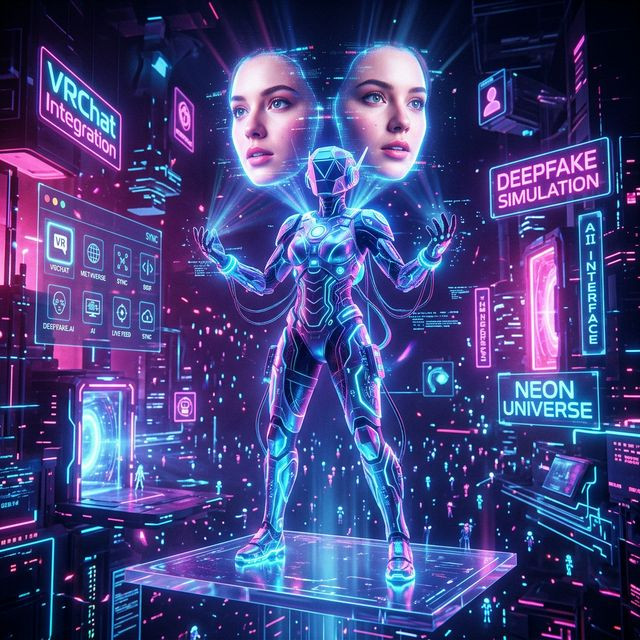
The Metaverse is heavily populated by anime girls, anthropomorphic creatures, and abstract shapes. While highly creative, navigating VRChat with a photorealistic, human-like avatar has always been the holy grail for mature digital interactions. Deep Live Cam acts as the ultimate rendering engine to bring true human expressions into the virtual realm.
The Virtual Camera Bridge in VR
Integrating 2D facial AI into a 3D environment requires a specific software pipeline. VRChat does not natively support running neural network scripts internally to replace your headset's tracked movements. However, VRChat *does* support video-planes and desktop streaming within private worlds or specific avatar components.
By capturing your physical face, passing it through the fast TensorRT processing of Deep Live Cam, and piping that output directly into a virtual display tethered to your VRChat avatar, you can present a hyper-realistic, fully lip-synced human face to anyone you interact with. This completely bypasses the need for complex, million-polygon 3D head modeling.
The Future of Digital Presence
As mixed reality (MR) headsets like the Apple Vision Pro and Meta Quest 3 become ubiquitous, the lines between physical webcams and virtual presence are blurring. Mastering face-swapping pipelines today prepares creators for the inevitable integration of native AI-assisted photorealistic avatars in the Web3 space.

