Creating Sci-Fi Digital Alien Masks with Deep Live Cam Algorithms
Creating Sci-Fi Digital Alien Masks with Deep Live Cam Algorithms
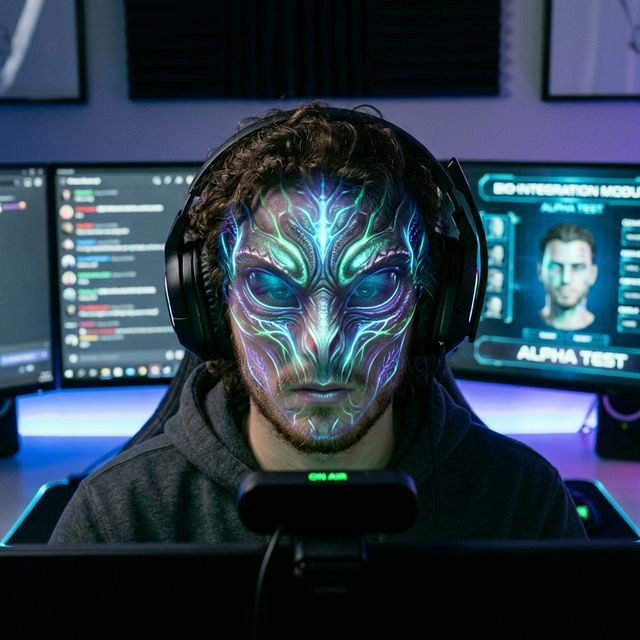
While the vast majority of Deep Live Cam users focus exclusively on human-to-human identity swapping, the underlying `inswapper` mathematical logic does not discriminate. It simply looks for a structure roughly matching the two eyes and a mouth. This opens an incredible, barely explored avenue for creative streamers and tabletop role-players: Real-time, photorealistic Sci-Fi alien generation.
Bypassing Biological Rules
By using external text-to-image generators (like Midjourney or Stable Diffusion), a user can generate a portrait of a Dungeons & Dragons Tiefling, a Mass Effect Asari, or a cyberpunk cyborg featuring glowing metallic plates embedded in the skin. As long as the AI prompt generates an image with distinct frontal facial landmarks (clearly defined eyes and a mouth), Deep Live Cam can wear it.
Because the software employs deep Poisson image blending, the edges of the metallic alien plates will naturally wrap around your actual jawline, and the ambient color correction will apply your physical room lighting perfectly onto the digital 3D sci-fi texture, creating an incredibly convincing mixed-reality prosthetic.
The Limitations of Non-Human Anatomy
However, the AI has distinct boundaries. You cannot map the face of a wolf, a dragon, or a heavily disfigured creature. If the geometry diverges too far from human eye-spacing and jaw-structure, the ONNX model will outright reject the image and throw an error. For the illusion to succeed, the alien or creature design must remain strictly humanoid in its cranial architecture.


