DeepFaceLive vs Deep Live Cam: Which AI Engine Should You Use?
DeepFaceLive vs Deep Live Cam: Which AI Engine Should You Use?
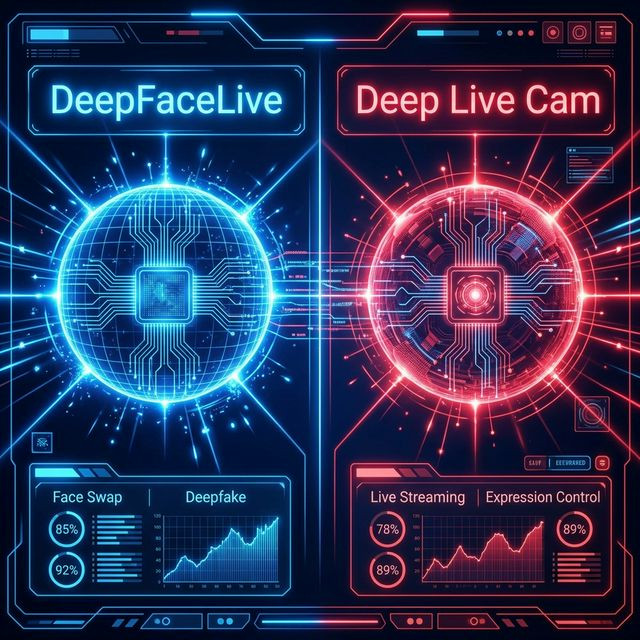
When searching the Github trenches for the best real-time AI face substitution tool, you will inevitably hit a fork in the road: DeepFaceLive and Deep Live Cam. Both architectures are monumental leaps in generative technology, but they cater to entirely different users with vastly different technical requirements. Understanding the nuances between these two software giants is critical before committing your hardware resources.
DeepFaceLive: The Heavyweight Champion
DeepFaceLive (created by Iperov, the genius behind DeepFaceLab) is the absolute industry standard for quality. It operates on trained discrete models. If you want to look identically like a specific Hollywood actor, you must train a proprietary SAEHD model using thousands of their photos over several nights on a high-end GPU. When applied, DeepFaceLive maps this custom-trained model onto your webcam feed with terrifying photorealism. However, it completely lacks "zero-shot" capability; you cannot just upload a random photo and swap instantly.
Deep Live Cam: The Agile Innovator
Enter Deep Live Cam. This software prioritizes fluidity, ease-of-use, and "Zero-Shot" architecture. It completely removes the multi-day training process. Supported by `inswapper` technology, you simply browse for one clear image of a face, click "Start," and the neural network calculates the feature geometry instantly. It requires significantly less VRAM, making it the preferred choice for streamers on laptops and those who want rapid, flexible character changes without a data science degree.
If you demand Hollywood composite quality and have the rendering farm to support it, DeepFaceLive is untouched. But for 95% of digital creators, VTubers, and zoom-trolls, Deep Live Cam is the vastly superior, pragmatic choice.

