Eliminating the Grey Mask: Inside Real-Time Color Correction Algorithms
Eliminating the Grey Mask: Inside Real-Time Color Correction Algorithms
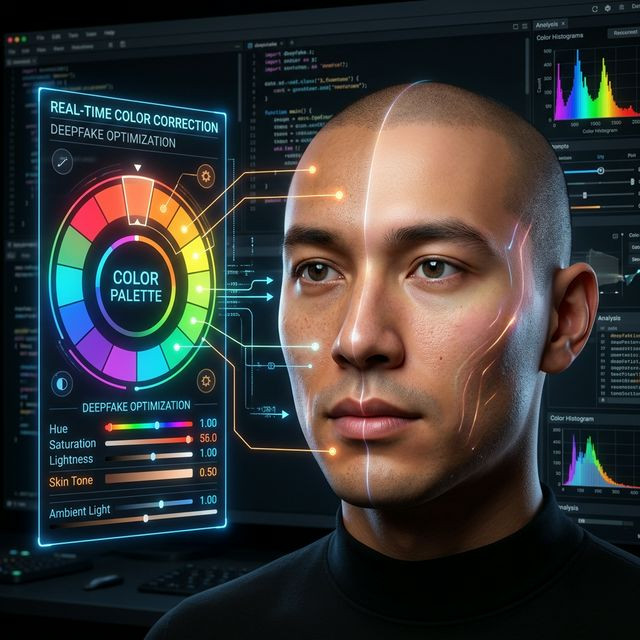
Everyone has seen a cheap deepfake. The structural geometry might be perfect—the eyes blink in unison, the jaw tracks correctly—but the face looks like a corpse pasted onto a living body. The skin tones don't match, and the shadow density is entirely wrong. In the visual effects industry, seamless blending is achieved through profound color correction algorithms. Deep Live Cam handles this autonomously, and the math behind it is fascinating.
The Histogram Matching Dilemma
Traditional image editing uses Histogram Matching. You take the color profile of the source webcam and force the target face to adopt an identical mathematical curve. However, in video, lighting changes dynamically. A streamer leans forward into a monitor's glow, or a cloud passes over the sun outside the window. Static color mapping fails instantly when the environment shifts.
Poisson Image Editing and Deep Color Transfer
Deep Live Cam circumvents cheap filtering by utilizing advanced techniques derived from Poisson Image Editing. Instead of just painting color on top of pixels, it analyzes the gradient fields. The neural engine understands that the *border* of the swapped face must gradually bleed the localized environment's RGB values inward.
Furthermore, internal color transfer nodes rapidly adjust the temperature and tint of the raw `inswapper` output *before* the Alpha blending stage. It calculates the ambient white-balance of the physical webcam feed every single frame, forcing the synthetic mask to adopt the exact same lighting constraints as the physical body underneath it. This computational heavy lifting is what truly destroys the "uncanny valley."

