The Shocking Impact of Poor Lighting on AI Face Tracking Accuracy
The Shocking Impact of Poor Lighting on AI Face Tracking Accuracy
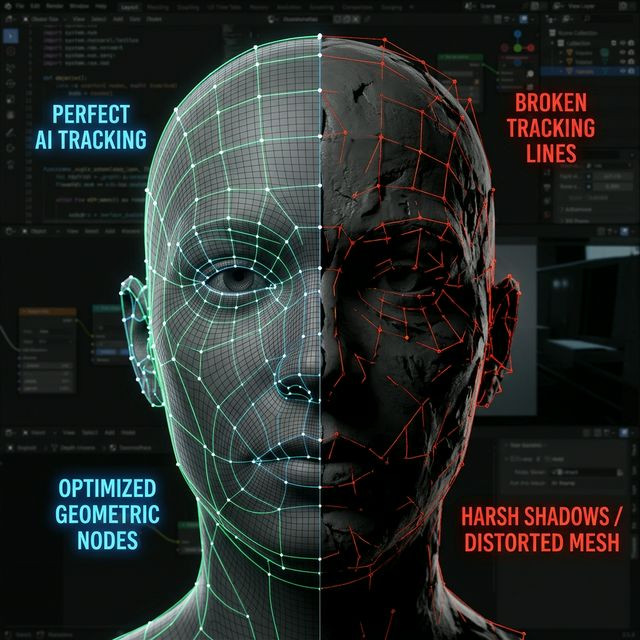
Artificial Intelligence interprets the world purely through contrast and data points. Millions of amateur streamers complain that Deep Live Cam randomly "disconnects" from their face when they look down, or that the digital mask violently flickers when they laugh. 95% of the time, this isn't a software bug—it is a catastrophic failure of physical room lighting.
The Contrast Dependency
The landmark detection algorithm algorithms search for distinct borders to anchor the 68 geometric points. The edge of your lip, the white of your eye against the pupil, the shadow beneath your jawline. If you stream in a dimly lit, "moody" room illuminated only by your monitor, those geometric borders blur into darkness. Without sharp contrast, the math fails, the landmarks drift, and the physical face mesh collapses.
The Split-Lighting Error
Worse than darkness is "Split Lighting"—having an incredibly bright window on the left side of your face while the right side is in heavy shadow. Because Deep Live Cam attempts to dynamically color-match the synthetic face to your environment, conflicting localized lighting creates a psychotic color map. Half your AI face might be glowing white while the other half turns a muddy, bruised purple. It destroys the illusion.
To ensure flawless tracking, utilize flat, diffuse lighting. A standard 18-inch ring light positioned directly behind the webcam, aimed straight into the face, eliminates rogue shadows and feeds pristine data to the tracking engine, resulting in an unshakeable, broadcast-ready digital masquerade.


