What is GFPGAN? Complete Guide to AI Facial Upscaling
What is GFPGAN? Complete Guide to AI Facial Upscaling
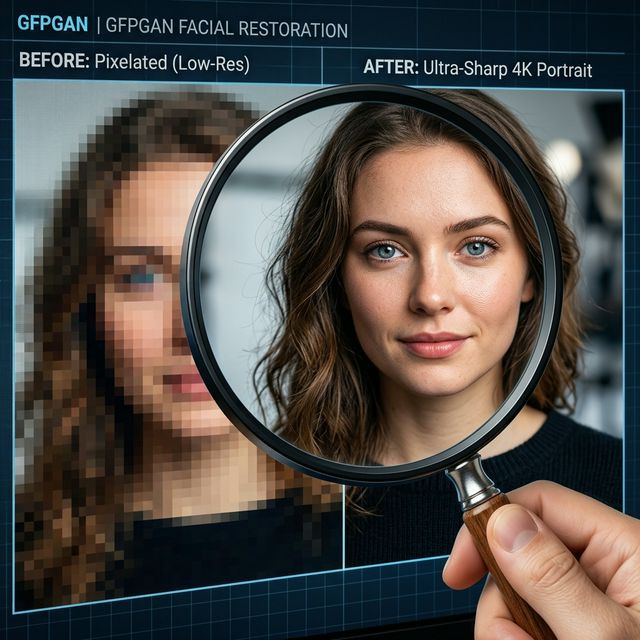
Within the Deep Live Cam interface, there is an incredibly taxing, but magical, checkbox labeled "Face Enhancer." Checking this box often drops your framerate by half, but visually upgrades the final result from a blurry, muddy mess into cinematic clarity. The architecture executing this magic is almost always GFPGAN (Generative Facial Prior Generative Adversarial Network).
The Blurry Inference Problem
To perform calculations in less than 30 milliseconds, the core `inswapper` model operates at extremely low resolutions—usually creating a facial region no larger than 128x128 pixels. If it tried to swap a 1080p face natively, your computer would catch fire. Therefore, once the swap is done, the software pastes a tiny, low-resolution 128p face back onto your high-definition body. The mismatch is jarring.
How GFPGAN Intervenes
GFPGAN acts as an incredibly potent "blind restoration" algorithm. As the raw, blurry frame exits the model, GFPGAN intercepts it. It has been trained on millions of high-definition human faces. It looks at a completely blurred cluster of brown pixels and mathematically guesses: *"Those pixels should represent eyebrows."*
It then actively redraws high-definition pores, eyelashes, light reflections, and sharp skin wrinkles based on what it *knows* a human face should look like. It is not reconstructing the original image; it is hallucinating realistic high-resolution details on top of the blur in real-time. This is why it requires massive VRAM overhead, but delivers undeniably professional results.

